Quality and Sustainability
Quinta de Vilar, mindful of market demands and competitiveness, continuously adopts procedures and standards that guarantee the recognition of its best practices and the quality of the products it markets.
01
Our Procedures

From production to shipping, the entire process is controlled and optimized to ensure high standards of quality, traceability, and customer trust.

01
Cultivation
Ramo jovem de árvore com folhas verdes e castanhas em fundo desfocado verde.

At Quinta de Vilar, apple cultivation strictly follows Integrated Production guidelines, ensuring sustainable agricultural practices and high-quality products:
• Selection of apple varieties suited to the region's geographical and climatic conditions.
• Exclusive use and recording of plant protection products authorized for orchards, in compliance with official lists.
• Compliance with the standards required for PGI (Protected Geographical Indication) and GLOBALG.A.P. certification, guaranteeing responsible and traceable agricultural practices.
02
Harvest
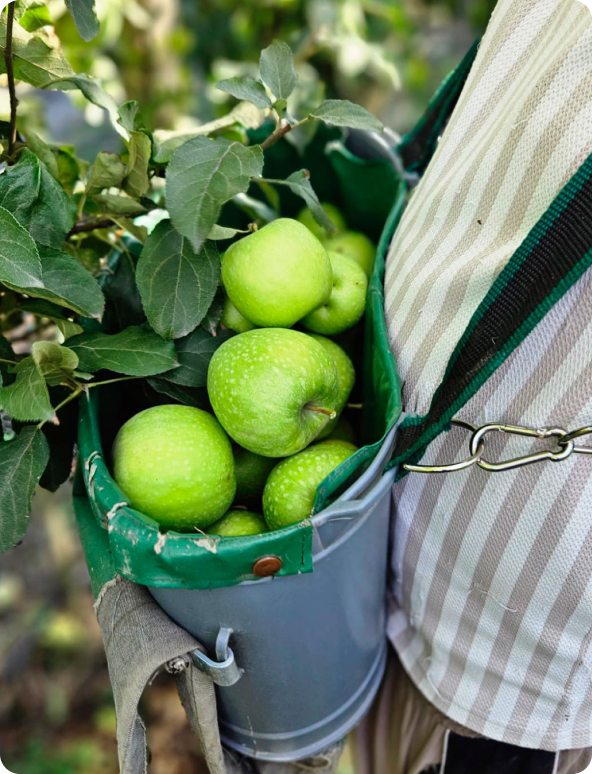
Cesto preso a um cinto cheio de maçãs verdes com folhas, usado por uma pessoa vestindo camisa às riscas.

Harvesting at Quinta de Vilar is planned based on precise analysis of fruit maturity and internal quality.

• Maturity assessment through the analysis of starch, sugars, acidity, and pulp firmness.
• Determination of the ideal harvest time based on analytical results.
• Strict compliance with hygiene standards throughout the entire process.


03
Delivery and Storage
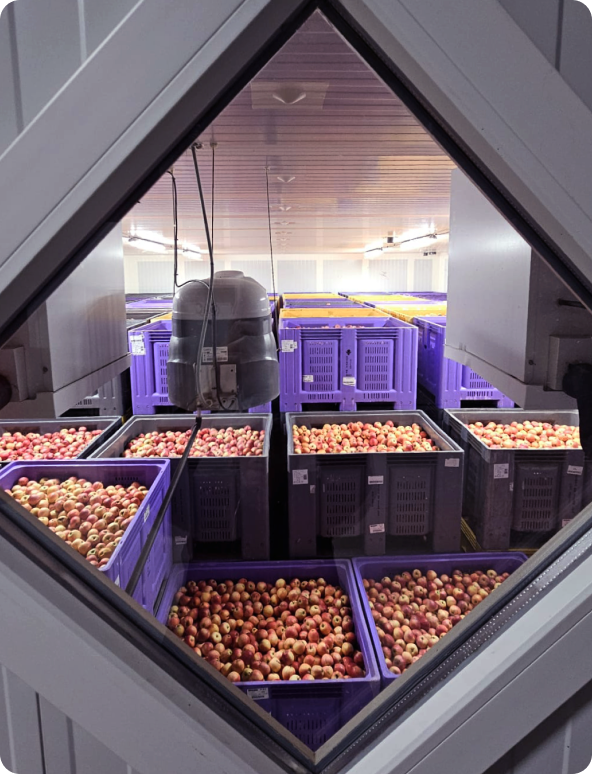
Paletes roxos e pretos cheios de maçãs num armazém refrigerado visto através de uma janela quadrangular.

Each batch of apples is identified and controlled to ensure full traceability and ideal preservation.

• Visual inspection of the harvest upon reception.
• Labeling of each bin with essential information: producer, orchard, variety, delivery date, production method, and quality.
• Sampling for pesticide residue analysis and risk assessment based on monitoring reports.
• Evaluation of internal quality parameters.
• Storage in controlled atmosphere chambers, adjusted to the apple type and preservation period (short, medium, or long term).

04
Grading and Classification
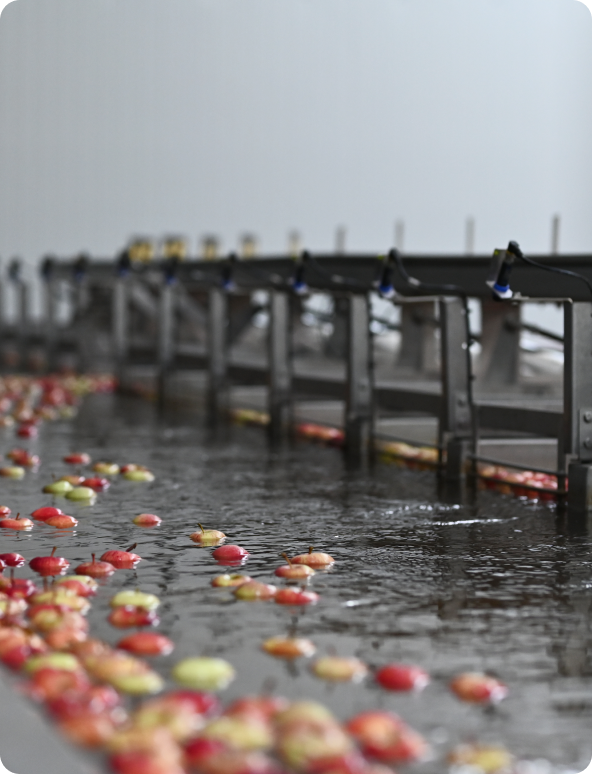
Maçãs flutuando numa correia de lavagem em linha de produção industrial.

The grading and sorting process is fully automated and excellence-oriented.

• Standardized grading and classification programs.
• Application of strict quality and labeling criteria.
• Post-classification labeling based on delivery information, ensuring full traceability.
• Quality control protocols and definition of size and category classes.


05
Packaging and Dispatch
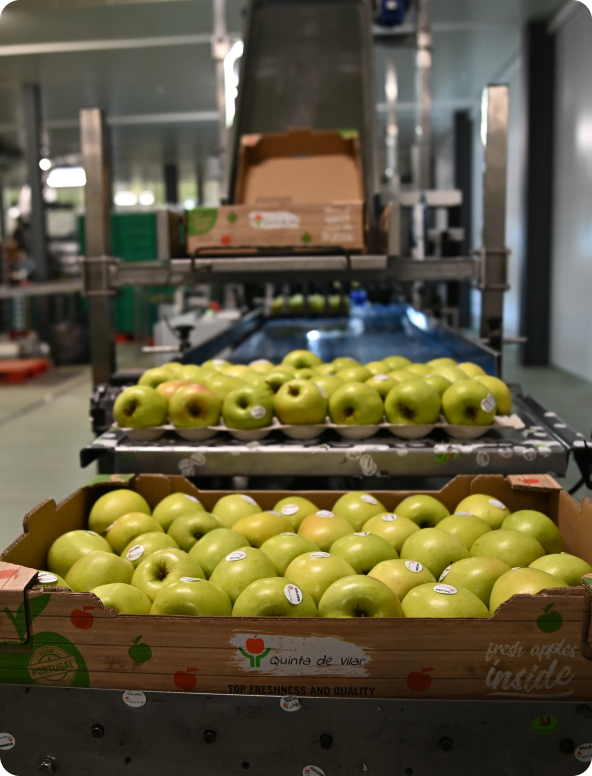
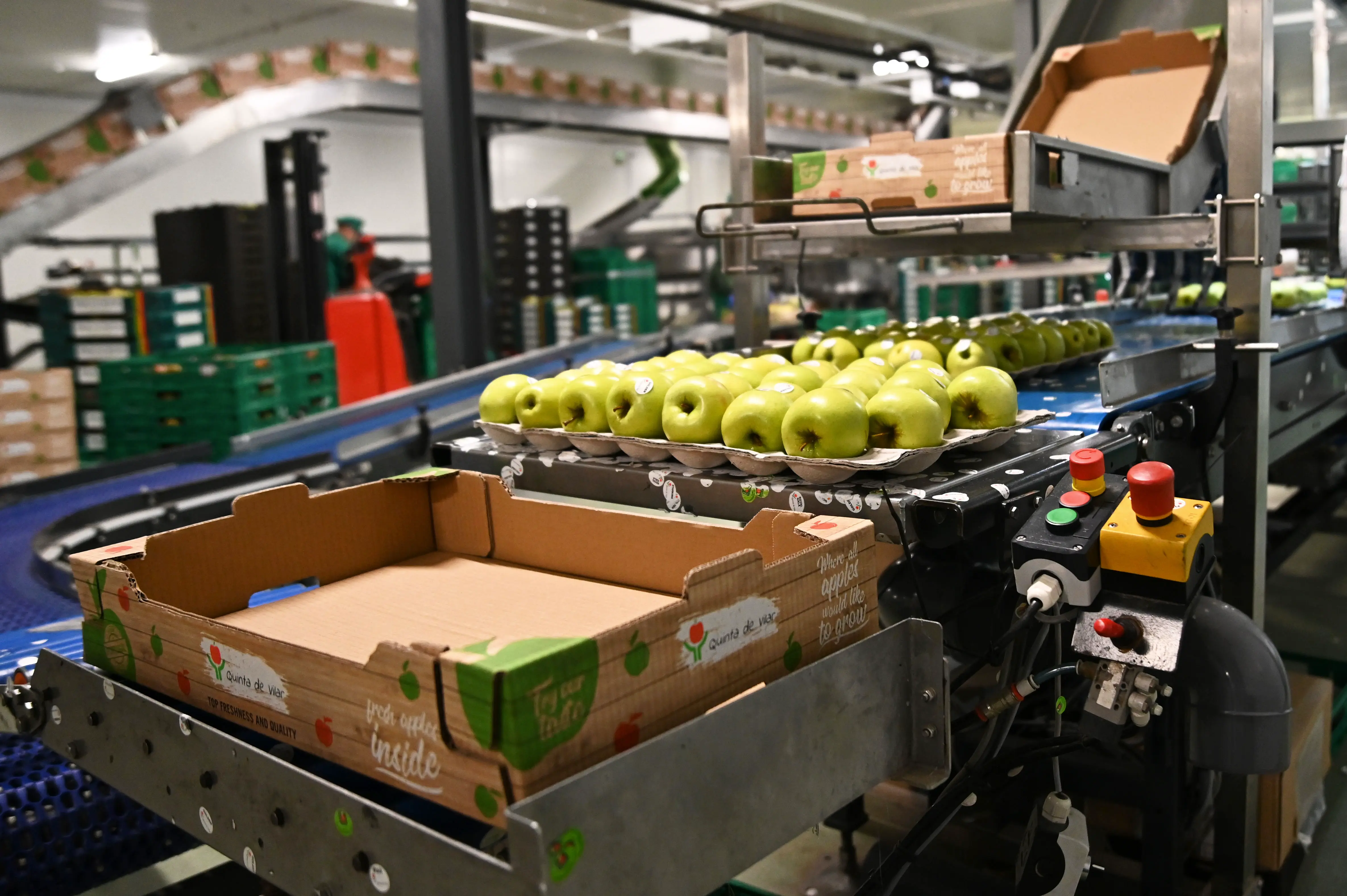
Maçãs verdes embaladas em caixas numa linha de produção numa fábrica.

The final stage combines modern technology with rigorous control, ensuring that the product reaches the consumer in prime condition.

• Selection of fruit according to each order's specifications and applicable quality standards.
• Traceability ensured through the indication of the packaging date, batch number, or reference code.
• Final inspection of products and packaging, ensuring compliance with marketing standards, certification norms, and the Quinta de Vilar brand usage regulations.

02
Certifications
Botão circular verde com uma seta apontando para a esquerda no centro.Seta verde apontando para a direita dentro de um círculo branco com borda verde.
Logótipo IFS Food com hexágonos verdes e azuis.

Certification obtained since 2019 and renewed annually, which ensures excellence in quality, food safety, and customer satisfaction, reinforcing trust in the distribution chain.

Logótipo da GLOBALG.A.P. em letras verdes com um grande G estilizado acima do texto.

Certification obtained since 2019 and renewed annually, which ensures excellence in quality, food safety, and customer satisfaction, reinforcing trust in the distribution chain.

Logotipo verde e amarelo com a frase 'Produção Integrada'.

Sustainable production system based on good agricultural practices and the rational use of natural resources.

Logótipo de maçã vermelha com folha verde e texto 'Maçã da Beira Alta' em fundo verde.

Certification reserved for apples with specific characteristics of flavor, sweetness, consistency, and coloring, resulting from the unique conditions of the region.

Selo vermelho e amarelo com texto 'Denominação de Origem Protegida' e estrelas circulares em volta de um campo estilizado.

Atribuída à maçã Bravo de Esmolfe, produzida na região de Esmolfe (Penalva do Castelo), reconhecendo a ligação entre o produto e o seu meio geográfico.

Símbolo circular azul e amarelo com doze estrelas e texto 'Indicação Geográfica Protegida'.

A certificação IGP reconhece a produção de maçãs com características únicas, resultantes das condições naturais e do saber local, garantindo origem controlada e qualidade superior.

Mão azul estilizada com o texto GLOBALG.A.P. GRASP abaixo.

A certificação GRASP reforça o compromisso da Quinta de Vilar com a responsabilidade social na produção agrícola

A certificação ZERYA® comprova o compromisso da Quinta de Vilar com uma produção natural e segura, garantindo frutas sem resíduos de pesticidas,

A  certificação EcoVadis distingue a Quinta de Vilar pelas suas boas práticas ambientais, sociais e éticas, reforçando o compromisso com um futuro mais sustentável.

Logótipo da Sedex com letra vermelha estilizada no final.

A certificação SEDEX reforça o compromisso com condições de trabalho justas, ética empresarial e responsabilidade social em toda a cadeia de fornecimento.

Logótipo verde da maçã Bravo de Esmolfe com texto 'Denominação de Origem Protegida' e 'Sabores da Origem'.

A certificação Maçã Bravo de Esmolfe garante o cumprimento de práticas tradicionais que preservam as características únicas do produto.

03
Sustainability

Throughout its journey, Quinta de Vilar has been adopting practices that promote environmental, social, and economic sustainability, implementing responsible production and consumption models with continuous measures to reduce its environmental impact.

Painel solar verde com um sol estilizado acima, representando energia solar.

Use of renewable energy

Quinta de Vilar has approximately one thousand solar panels, significantly reducing energy consumption from non-renewable sources.

Solar energy, being inexhaustible, clean, and sustainable, contributes to decreasing the ecological footprint and reinforces the Quinta's commitment to environmental preservation.
Ícone de gota de água com setas circulares ao redor representando reciclagem ou sustentabilidade da água.

Water conservation

The entire production area features a drip irrigation system, ensuring precise irrigation without waste.
The dam, with a capacity of 100,000 m³, allows for autonomous and sustainable water management, even during periods of low rainfall. Water also plays an essential role in apple grading.

Quinta de Vilar utilizes a hydro-conveyor system that prevents fruit damage, combined with a filtration and disinfection system using sand and carbon filters and UV lamps, ensuring clean, safe, and reusable water for longer periods.
Ícone verde simples representando sol, pássaro, cogumelo e planta.

Ecosystem Protection

Quinta de Vilar promotes agriculture in harmony with biodiversity, creating strips of native vegetation that serve as ecological corridors and wildlife refuges.

At the borders of the orchards, flowers that attract pollinators enhance the presence of bees and beneficial insects.

Biological pest control is achieved through natural enemies, the release of beneficial organisms, and mating disruption techniques, reducing the use of chemical pesticides.
Símbolo de reciclagem verde com três setas formando um triângulo.

Waste management

With the aim of combating food waste, Quinta de Vilar was also the origin of the Fruut brand, created to give value to "ugly" apples that were previously rejected by the market.

Organic waste resulting from apple pruning and harvesting is directed to a composting system, where it is transformed into natural fertilizer, subsequently used to fertilize the orchards.

It also encourages the recycling, reduction, and reuse of plastics, as well as the use of reusable pooling systems such as Euro Pool, IFCO, and CHEP for packaging and pallets, promoting circular logistics and reducing packaging and transport waste.